Seventy-five spoken positions, a median of 86 views
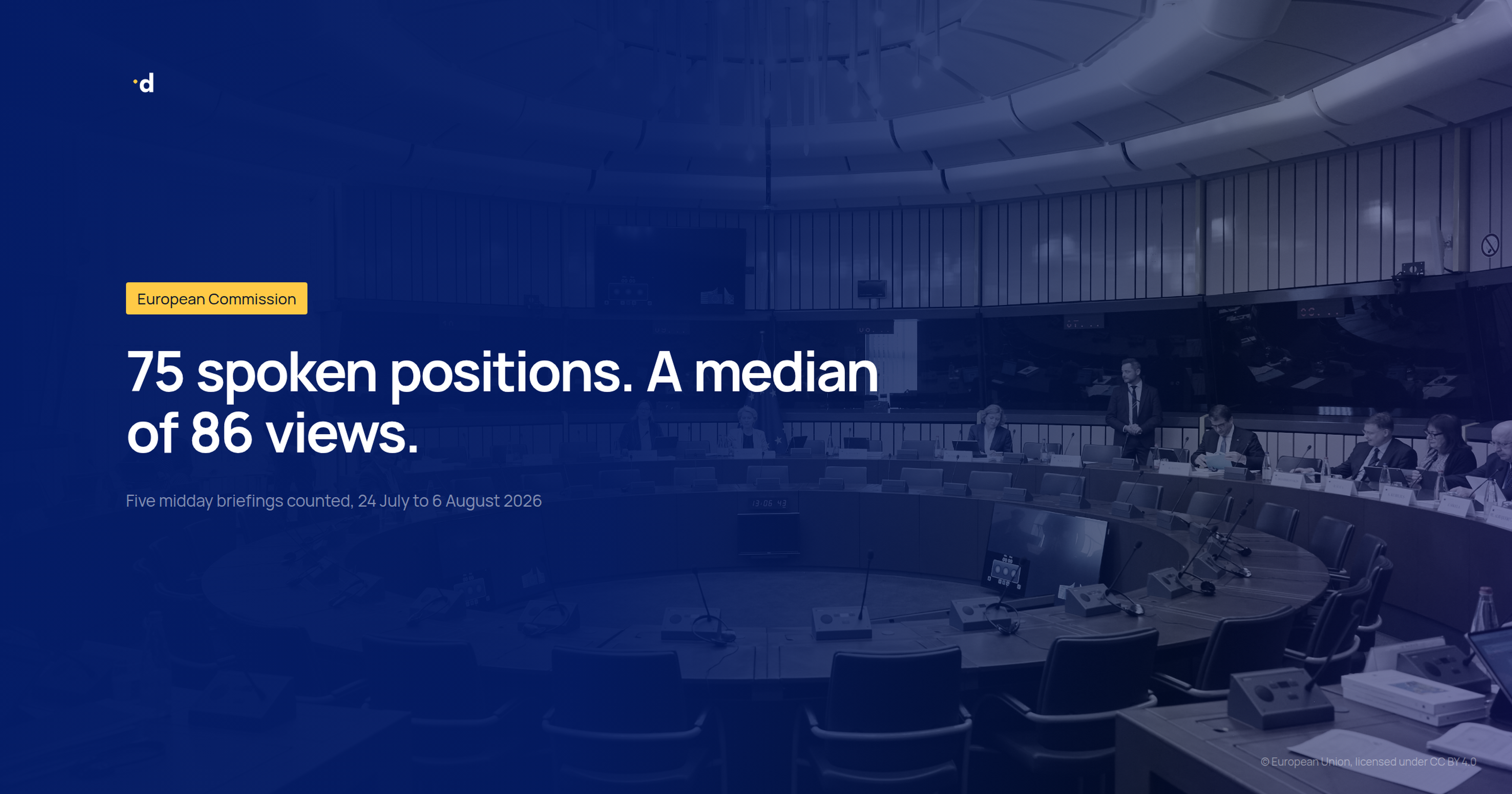
Across five midday briefings published between 24 July and 6 August 2026, the European Commission put out 75 separate recorded answers, totalling 3 hours and 47 minutes. Each one is dated, attributed to a named spokesperson, tagged, and comes with a downloadable transcript. On the eight chapters we sampled, the median view count was 86. The lowest was 46.
How we counted
We opened the five most recent midday briefings available on the Commission's Audiovisual Service portal before 11 August 2026, and read the chapter count and total duration off each briefing page: 8 chapters on 6 August, 10 on 4 August, 20 on 30 July, 19 on 28 July, 18 on 24 July. We then opened eight individual chapter pages spread across those five days and recorded the spokesperson, the duration and the view counter shown on each.
Everything in this article was read directly off the public portal on 11 August 2026. No API, no export, no privileged access. That matters, and we come back to it.
The Commission segments its own speech, and hands you the index
A midday briefing is not published as one recording. It is cut into named chapters, one per topic, and each chapter is a separate item with its own page.
Take 30 July: twenty chapters, from the transparency of documents to the 21st package of sanctions against Russia, from AI gigafactories to the Entry Exit System, from Hungary's recovery plan to wildfires. Twenty distinct subjects, isolated and titled by the institution itself, in one lunchtime.
Each carries a record: an identifier, a date, a duration, language versions, the name of the spokesperson who answered, sometimes tags, and a view counter. Under a Downloads tab sit the video, the audio, subtitles in VTT and the transcript as a document.
The segmentation work is already done, by the institution, about its own communication. Someone decided the SAFE and Italy exchange of 28 July deserved to be a separate item from the sanctions exchange the same day. That judgment is a free taxonomy of institutional attention, more honest than any topic model you could build over the same material.
What a spokesperson says that no written document carries
A press release states a settled position. It is drafted, cleared and timed, which is why it rarely tells you anything you had not already assumed.
A briefing answer is a different object. A spokesperson stands in front of journalists who ask when, why not, what happens if a member state objects, and whether the date still holds. Those answers carry three things written communication is built to remove.
Calendar. On 24 July the briefing carried an announcement of the summer schedule itself, alongside preliminary findings against TikTok under the Digital Services Act and a 890 million euro fine against Google under the Digital Markets Act. Timing on enforcement is stated out loud in these sessions before it is confirmed in writing.
Caveat. The 21st package of sanctions against Russia came up in three of the five briefings, each time from a different angle: Irish alumina exports, the Kulevi oil terminal in Georgia, exemptions concerning Greece. Those are the qualifications attached to a commitment in real time, the clauses that resurface months later in a recital.
Refusal. "I am not going to comment at this stage" is a position. Recorded, dated and attributed to a named spokesperson, it is a position you can cite back.
The archive is barely read, and it cannot be searched
The median of 86 views is the first half of the problem. On 30 July, the exchange on the AI Act and the publication of images had 62 views. The exchange on the International Criminal Court on 24 July had 46. These are files that mobilise entire associations.
The second half is worse, and we hit it while collecting the data for this article. The portal's search function does not work. The text parameter is stripped from the URL, typing in the search field does not change the results, each category is capped at twelve items, and there is no pagination: the button at the bottom of the results list takes you back to the top of the page. We were only able to assemble this count by navigating directly by media identifier, one page at a time.
So the situation is this. The Commission publishes, transcribes, segments, tags and attributes several hours of spoken position every week, and then offers no way to search any of it. Publication was solved. Retrieval was not.
What this changes for you
If you follow a file at European level, there is a recurring gap between the moment the Commission says something about it and the moment that something appears in a document you monitor. That gap is where these chapters live, and it is typically several days wide.
The cost is not missing a headline. It is arriving at an internal meeting with a position paper built on the written record while a counterpart quotes a spokesperson who qualified that position out loud eleven days earlier. Dated attribution turns "the Commission is said to be considering" into something you can put in front of your board.
There is a second use that is routinely overlooked: the journalists' questions. When three outlets press the same angle on the same day, something is moving that has not yet been written. Reading the questions is reading next week's press before it is published.
The limits of this count
The period is not representative. These five briefings fall in the summer schedule, and the 24 July briefing carries an explicit announcement to that effect. They are not five consecutive working days: there was no midday briefing on 25, 26, 27, 29 or 31 July, nor on 3, 5 or 7 August. Chapter volume in an ordinary week is likely higher, not lower, which makes the retrieval problem worse rather than better.
The view sample is small. Eight chapters out of seventy-five. The median of 86 is an order of magnitude, not a measurement. We also do not know what the counter counts: unique visitors, cumulative loads, or something else. The portal does not say.
The transcripts are automatically generated, and the player says so. Automatic transcription is weakest on proper names, acronyms and file numbers, which are dense in a Brussels briefing. Treat a transcript as an index into the recording, not as citable verbatim. Before a sentence goes into a note, listen to it.
Metadata is inconsistent. Tags were present on only one of the eight chapters we sampled. The spokesperson field was missing on one. Briefing titles changed format between 24 and 28 July. Any process built on these fields needs to tolerate their absence.
What to do with this
Stop treating it as media and start treating it as text. A transcript is a document, and once it is a document it can be matched against your file list, your tracked spokespersons and your keyword set, exactly like a parliamentary question or a consultation contribution. The recording then becomes what it should have been all along: the place you go to verify the four minutes a match surfaced.
Match on the file, not on the clip. A subject raised in two separate exchanges produces two items, and reading one gives you half the position.
Watch the questions, not only the answers, and log which outlets are pressing.
Do not build a daily viewing habit. Nobody sustains forty-five minutes of video a day, and any process that depends on someone doing so lapses within a month.
And whatever you use to do this, insist on retrieval rather than access. Access to this material has never been the constraint. We added these transcripts to Dixit for that reason, but the test applies to any setup: if you cannot search three hours of spoken position by file name, you do not have the source, you have a link to it.
Questions and answers
Does the European Commission publish transcripts of its press briefings?
Yes. Each midday briefing chapter on the Audiovisual Service portal offers subtitles in VTT format and a downloadable transcript, in the original language and in available language versions. The portal states on the player that subtitles are automatically generated.
How many topics does a Commission midday briefing cover?
In the five briefings we counted between 24 July and 6 August 2026, between 8 and 20 chapters each, 75 in total, averaging 15 topics and 45 minutes per briefing. Volume varies with the news and with the summer schedule.
Can you search the Commission's audiovisual archive?
Not reliably. As of 11 August 2026 the portal's text search returns unfiltered results, each category is capped at twelve items and there is no pagination. Navigating directly by media identifier is the only dependable route.
How is a midday briefing different from a Commission press release?
A press release is a cleared written position. The briefing is a spokesperson answering unscripted questions on the record. It routinely contains timing, qualifications and explicit refusals to comment that no written communication carries.
Is it worth monitoring the briefing for a technical file raised only occasionally?
Often more so. On a file raised twice a year, those two exchanges are the only spoken record you will get, and their scarcity makes them easier to catch with a keyword match than by browsing.
Sources
European Commission, Audiovisual Service. Five midday briefings, chapter counts and durations read from the briefing pages: 6 August 2026 (8 chapters, 39:47), 4 August 2026 (10 chapters, 22:28), 30 July 2026 (20 chapters, 57:21), 28 July 2026 (19 chapters, 1:03:06), 24 July 2026 (18 chapters, 44:58). Total 75 chapters, 3 hours 47 minutes.
View counts sampled on eight chapters: 241, 259, 78, 104, 62, 94, 75 and 46. Median 86. Chapters cited include SAFE and Italy of 28 July, the AI Act and publication of images of 30 July, and the International Criminal Court exchange of 24 July.
Portal: audiovisual.ec.europa.eu. All figures read on 11 August 2026.
European Commission, Audiovisual library and services, Directorate-General for Communication.