The short answer
Between June 2023 and May 2026, DG GROW (Internal Market, Industry, Entrepreneurship and SMEs) published more initiatives open to feedback than any other Commission department: 98 out of the 996 we analysed. The directorate-general that received the most input over the same period is DG SANTE (Health and Food Safety), with 220,286 contributions, followed by DG ENV (Environment) with 135,426. Those two DGs alone account for 71 percent of the half million contributions filed on the Commission's Have your say portal during the period.
What we measured, and how
This analysis covers the 1,000 most recent European Commission initiatives opened for stakeholder feedback on the Have your say portal, from June 2023 to May 2026, as indexed in Dixit Platform's consultation database. The term "initiative" covers everything the Commission submits to public input: calls for evidence, public consultations, and draft legal acts published for feedback. Each initiative is attributed to its lead directorate-general; 996 of the 1,000 carried a DG attribution. Contribution counts are those displayed on the portal at the time of collection.
One structural fact is worth keeping in mind before reading the rankings: 49 percent of these initiatives are draft implementing or delegated acts. The bulk of what the Commission opens to feedback is not headline legislation but the technical layer beneath it, where feedback windows are short and participation is thin.
Which DGs publish the most consultations
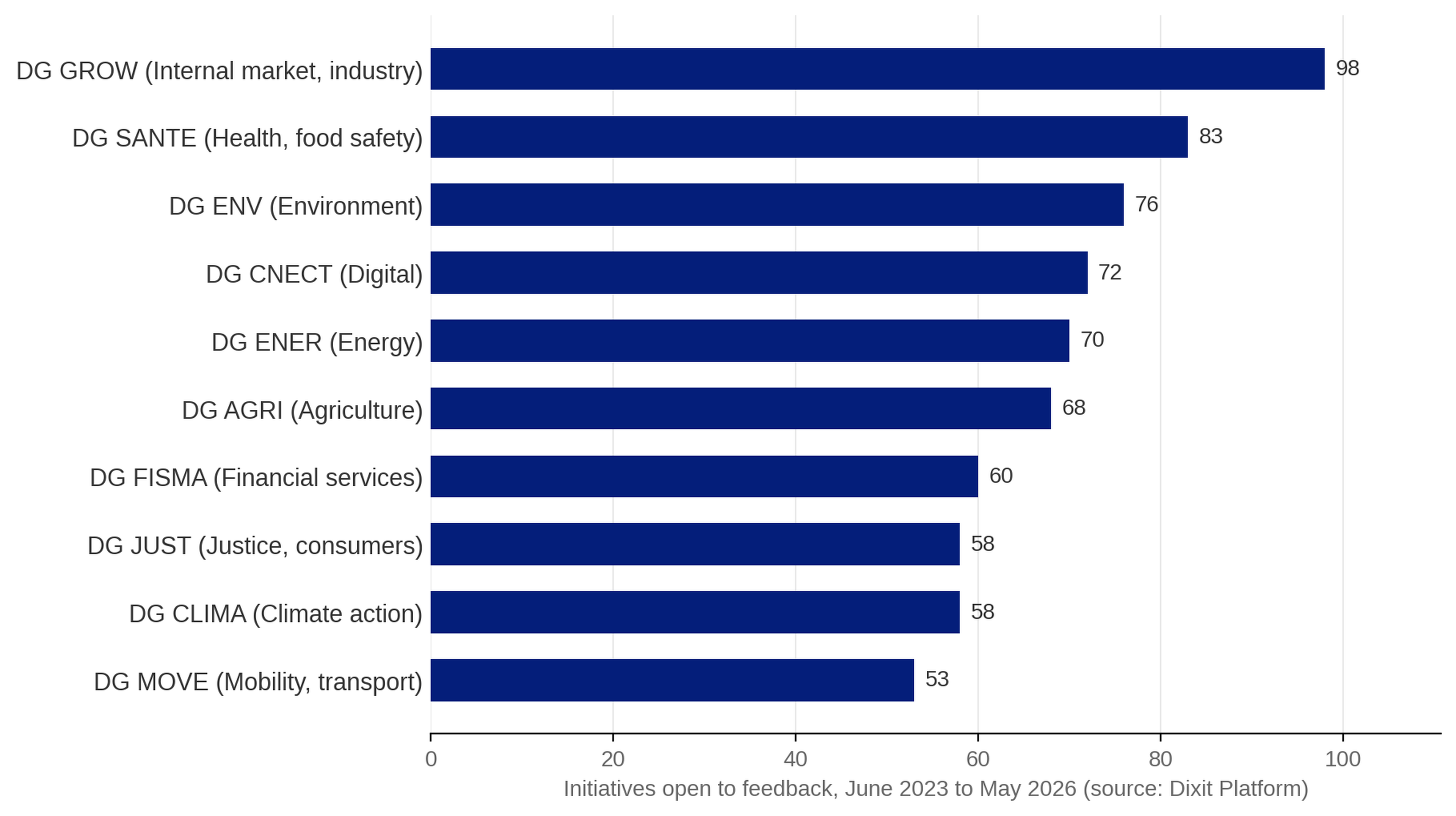
The top of the ranking maps the Commission's regulatory output fairly faithfully. DG GROW leads with 98 initiatives, a reflection of how much single market and industrial policy runs through secondary legislation. DG SANTE follows with 83, driven by food safety acts that require constant technical updating. DG ENV (76), DG CNECT (72) and DG ENER (70) complete the top five, with agriculture, financial services, justice, climate and transport close behind.
The spread is tighter than one might expect: ten DGs each published more than 50 initiatives in three years, which means a public affairs team covering two or three policy areas is realistically tracking a consultation flow of one to two new items per week.
Which DGs attract the most contributions
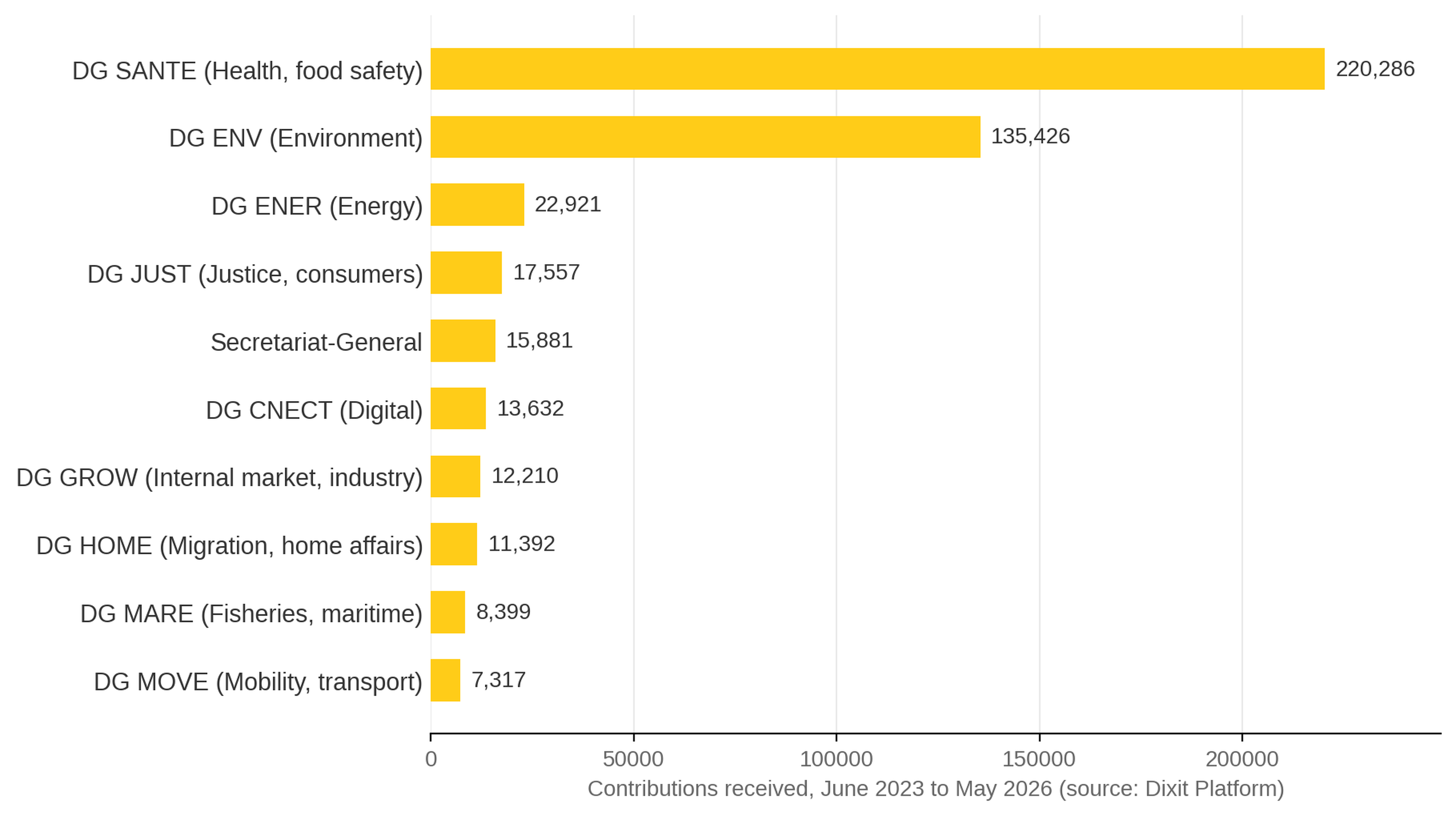
The contributions map looks nothing like the publication map. DG SANTE and DG ENV tower over everyone else, and the Secretariat-General reaches fifth place with only 16 initiatives, because it carries Commission-wide exercises such as simplification agendas that draw input from every sector at once.
The concentration is extreme. The ten most commented initiatives of the period captured 72 percent of all contributions. The median initiative received just 25 contributions, and 31 percent received ten or fewer. Public participation in EU rule-making is not a steady stream; it is a handful of floods in a landscape of trickles.
Publication volume and mobilisation are two different maps
Comparing the two rankings yields the most useful insight of the dataset. DG GROW publishes the most but averages around 125 contributions per initiative. DG SANTE averages more than 2,600, yet that figure is an artefact of a single file: the modernisation of EU animal welfare legislation, which alone collected 181,508 contributions, the largest of the period. Strip it out and DG SANTE's average falls to roughly 470. The same applies to DG ENV, whose total is inflated by the consultation on simplifying administrative burdens in environmental legislation (97,504 contributions).
In other words, no directorate-general has a structurally mobilised audience. What exists are mobilisable topics: animal welfare, tobacco rules (19,281 contributions), trade in seal products (17,761), affordable housing (13,657). These are consumer-facing, emotionally legible issues where NGO and citizen campaigns can convert public sentiment into mass submissions, often through pre-filled forms.
What the mega-consultations have in common
The files that draw five or six figure participation share three traits. They touch daily life or widely held values rather than industrial process. They are championed by organisations with large supporter bases able to run submission campaigns. And they tend to arrive at the evaluation or proposal stage, where the question asked is broad enough for non-specialists to answer.
For the organisations responding, this changes the nature of the exercise. In a consultation with 180,000 contributions, a single response carries almost no statistical weight; what matters is whether your argument is distinct, evidenced and quotable when the Commission's services synthesise the results. The Commission's own summary reports routinely separate campaign-generated submissions from substantive position papers, and treat them differently.
What this means for a public affairs strategy
The data points to two distinct regimes, each with its own playbook.
In the crowded regime, the high-mobilisation files, visibility comes from coalition work and from submissions that bring original evidence rather than volume. Being one voice among 100,000 is only useful if your voice is the one the case handler can cite.
In the quiet regime, which is most of the flow, the leverage is inverted. Nearly a third of initiatives close with ten or fewer contributions, and half of all initiatives are technical implementing or delegated acts with feedback windows of about four weeks. In these files, a single well-argued contribution from an affected industry can visibly shape the final text, simply because the case handler has little else to weigh. The hard part is not drafting the response; it is knowing the window is open at all. That monitoring problem is precisely why we built consultation tracking into Dixit, because a four-week window on a delegated act rarely announces itself.
The practical conclusion: a public affairs team should not allocate effort in proportion to a consultation's visibility. The quiet technical files are statistically where individual influence is highest.
Questions we hear from public affairs teams
What is the difference between a call for evidence and a public consultation?
A call for evidence is a short document published early in the policy cycle, describing the problem and possible options, open for feedback for four weeks. A public consultation is a structured questionnaire, usually open for twelve weeks, used to collect detailed stakeholder views on a planned initiative or an evaluation. Both are hosted on the Commission's Have your say portal, and a single initiative often goes through both stages.
How long do you have to respond to an EU consultation?
Standard windows are four weeks for calls for evidence and for draft implementing and delegated acts, eight weeks for feedback on adopted legislative proposals, and twelve weeks for public consultations. Deadlines are occasionally extended, but planning should assume the standard window.
Do contributions to EU consultations actually influence legislation?
Yes, with a caveat: influence correlates with substance, not volume. The Commission's services must summarise consultation input in their impact assessments and explain how it was taken into account. Contributions that bring verifiable data, implementation experience or legally precise drafting suggestions are the ones that surface in those summaries, particularly in low-participation technical consultations.
Which DG should my organisation monitor most closely?
Map your sector to lead DGs rather than watching the portal globally: GROW for industrial and single market files, SANTE for food and health, ENV and CLIMA for environment and climate, CNECT for digital, ENER for energy, FISMA for financial services. Then track the implementing and delegated acts under the framework legislation that governs your activity, because that is where half of the consultation flow happens and where windows are shortest.